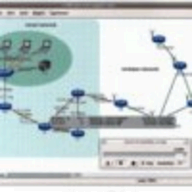
GNS3 is a network software emulator that allows you to design complex network topologies and test them virtually.
Best ns-3 Alternatives ranked by AI · updated Aug 2026
ns-3 is an open-source discrete-event network simulator for studying protocols, traffic, wireless systems, and large network scenarios. It is primarily used by researchers and educators who need detailed, repeatable simulation models rather than Mininet's real-time Linux network emulation.
Top 6 ns-3 alternatives
EVE-NG is a browser-based network emulation platform for assembling labs from virtual network appliances, servers, and security devices. It targets network engineers,...
Pros
- More realistic vendor appliance labs than Mininet
- Browser-based access simplifies centralized lab delivery
- Strong support for multi-vendor routing, switching, and security scenarios
Cons
- Usually needs more CPU, memory, and storage than Mininet
- Many appliance images require separate vendor licensing
- Less convenient for programmatic SDN topology generation
Free Community edition; paid Professional edition

Mininet is an open-source network emulator for creating virtual hosts, switches, links, and controllers on a Linux system. It is mainly used...
Pros
- Excellent OpenFlow and SDN controller integration
- Lightweight process-based emulation runs on ordinary Linux hardware
- Python API makes topology automation straightforward
Cons
- Linux-focused and less turnkey than graphical network simulators
- Provides less vendor-specific device fidelity than GNS3 or EVE-NG
- Shared-kernel emulation limits isolation between virtual hosts
VNX is an open-source tool for building and running virtual network scenarios on Linux. It is intended for networking education, experimentation, and...
Pros
- Supports repeatable, multi-node virtual network scenarios
- Uses standard Linux networking and virtualization components
- Suitable for teaching and protocol experimentation
Cons
- More difficult to configure than GNS3 or EVE-NG
- Primarily designed around Linux hosts
- Smaller community and ecosystem than mainstream network emulators

Cloonix is an open-source network emulator for Linux that connects virtual machines, containers, and network nodes in configurable topologies. It is aimed...
Pros
- Provides a graphical topology editor rather than requiring a purely command-line workflow
- Supports virtualized Linux nodes and configurable virtual networks
- Free and open source for private network experimentation
Cons
- Smaller community and ecosystem than GNS3 or EVE-NG
- Linux-focused setup is less accessible than cross-platform desktop tools
- Has fewer ready-made vendor appliance integrations than major commercial-oriented platforms
Kathara is an open-source network emulation platform that uses containerized nodes to create reproducible virtual labs. It is designed for networking education,...
Pros
- Container isolation is stronger and more flexible than Mininet's shared processes
- Supports reproducible labs across Linux, macOS, and Windows environments
- Accessible command-line and graphical workflows for teaching
Cons
- Less specialized for OpenFlow and SDN controller research than Mininet
- Requires familiarity with containers and Docker networking
- Less vendor-device fidelity than GNS3 or EVE-NG
How good are these alternatives?
Your feedback helps us improve the AI rankings.
✅ Thanks for your feedback!
Know a better alternative? 🙌
Suggest a product and our AI will verify it's a real alternative to ns-3 before adding it to the list.